
Riverlands commemorates the history and culture of South Africa’s First Nations in a custom-designed, multi-million rand Heritage Centre. The Centre consists of a multi-purpose building featuring an impressive 8-metre high mural overlooking a garden of traditional Khoi and San medicinal plants, and a grassed Gathering Space for concerts and other cultural events.
The Heritage Centre is owned and managed in perpetuity by the Western Cape First Nations Collective, and is the focal point of First Nations cultural resurgence in South Africa. The Centre hosts an important collection of historical artefacts, an exhibition space for contemporary artists, an educational facility for the transmission of Khoi and San languages and traditional knowledge, a media centre, and a venue for local and international indigenous people’s conferences.

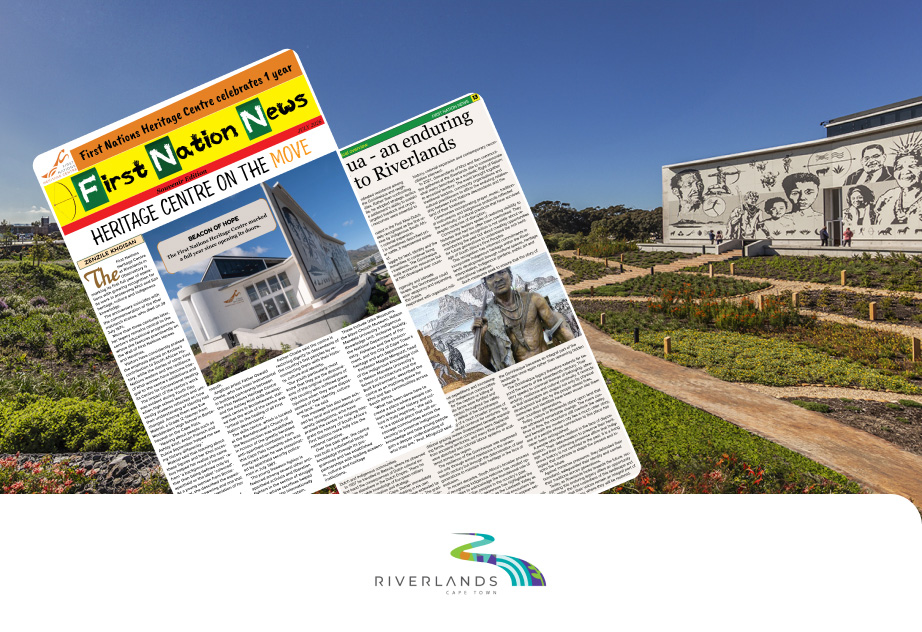
First Nations Heritage Centre celebrates 1 year
The First Nations Heritage Centre at Riverlands in Observatory is marking its first full year of operations with growing recognition for its work in preserving Khoi and San heritage, culture and indigenous knowledge. The anniversary coincides with the commemoration of the Khoi matriarch Krotoa, who died on 29 July 1674.
More than three centuries later, her legacy remains central to the centre’s educational programmes, where she features prominently on the Wall of First Nations Heroes and Heroines.
DOWNLOAD
The First Nations Sentinels
Anchoring the east-west axis of the Riverlands precinct are two eight-metre high triangular columns or ‘sentinels’. The Sunset Sentinel, facing west, acknowledges the past, and celebrates the traditional knowledge of South Africa’s First Nations, while the Sunrise Sentinel greets the rising sun and welcomes the future of our ancient cultures. Each is adorned with nine significant symbols deeply woven into the cosmology, social constructs, rituals and spirituality that uniquely define South Africa’s foundational peoples, the San and the Khoi.
The Sunrise Sentinel
The Cape Wild Dog
Structure, compassion, protection
Structure, compassion, protection
The Cape Wild Dog, a symbol in the Gorinhaiqua Cultural Council's masthead, represents their successful campaign for the First Nations Heritage Centre in the Riverlands precinct. This animal is known for its highly developed social structure and its compassionate, protective nature towards the pack's young, weak, and vulnerable.
READ MORE »
The Khoi Pot
Cohesion and cultural sustenance
Cohesion and cultural sustenance
The Khoi pot, a significant cultural symbol for the Khoi and San peoples, dates back about 2,000 years. Its unique conical shape served various purposes, including cooking and transporting provisions for migrant herding clans. Due to its importance, the Khoi pot was chosen as the emblem for the 2001 Khoi-San Consultative Conference, symbolising the unity of First Nations clans.
READ MORE »
The Aloe
Healing
Healing
The Cape or Red Aloe (Aloe ferox) is a succulent indigenous to Southern Africa, integral to Khoi and San indigenous knowledge and healing. For centuries, it's been used medicinally for skin conditions and internal ailments. This distinctive plant's super-food qualities also make it prevalent in many health supplements and cosmetics.
READ MORE »
The Red Disa
Resplendent beauty
Resplendent beauty
The Red Disa flower Disa uniflora Bergius, is the second element in the Gorinhaiqua Cultural Council's masthead. This dramatic, indigenous orchid thrives in the moist kloofs of Hoerikwaggo (Table Mountain) and other Western Cape mountains. It's also the official floral symbol of South Africa's Western Cape province.
READ MORE »
The Meeting Place
Consultation and governance
Consultation and governance
The Meeting Place symbol, part of the Western Cape First Nations Collective's insignia, is recognised globally among First Nations. Convergent lines represent diverse paths coming together for deliberation, decision-making, and governance. Inner circles denote leadership, with the overall circular design reflecting how councils or clans gather to decide matters.
READ MORE »
The Protea
Adornment
Adornment
The Protea, an iconic South African plant endemic to the Cape floral kingdom, is internationally recognised. Khoi and San people have long used it as a primary adornment for indigenous ceremonies and gatherings. Its medicinal efficacy and culinary uses are also incorporated into our indigenous knowledge systems.
READ MORE »
The Praying Mantis
Spiritual guide
Spiritual guide
IKaggen, or the Praying Mantis, is a revered figure in Khoi and San indigenous knowledge. Woven into folklore, this trickster-deity can change form and serves as a potent spiritual guide. Its appearance at a home's threshold signals good tidings.
READ MORE »
The Tortoise Shell
Discretion and confidentiality
Discretion and confidentiality
The Tortoise Shell holds special significance for the Khoi and San of Southern Africa, symbolising leadership and discretion in indigenous knowledge. Often gifted to new leaders, it embodies core values like confidentiality and respect for internal matters. The shell reminds leaders to exercise discretion, upholding community trust and their leadership integrity.
READ MORE »
The Eland
Hope and resilience
Hope and resilience
The Eland, the largest antelope, holds immense spiritual and cultural significance for Southern Africa's First Nations. Often seen in rock paintings, it symbolises our ancient heritage, ancestral journeys, and our role as custodians of the land. The Eland embodies hope and resilience, playing a central role in many Khoi and San rituals.
READ MORE »
The Sunset Sentinel
The Moon
Renewal and affirmation
Renewal and affirmation
For the Khoi and San, the moon symbolises renewal and our universal connectedness. It aligns with the !Nau ceremonies, which define indigenous identity from birth to death. The declaration of indigenous identity is conducted with the new moon. Under the full moon, there's thanksgiving to the creator and a call for guidance.
READ MORE »
The Bow & Arrow
Responsibility
Responsibility
The bow and arrow are prominent symbols for the Khoi and San. In indigenous protocols, they define responsibilities of stewardship and custody: sustaining life and maintaining order. During the final !Nau ceremony, the bow is broken, signifying the fallen steward's faithful fulfilment as defender and provider. Arrows are then passed to the children, who must follow this time-honoured tradition.
READ MORE »
The Snoek
Marine indigenous knowledge
Marine indigenous knowledge
The snoek is a key symbol for South Africa's Khoi and San, who have centuries of coastal habitation. The art of reading migration patterns and harvesting this staple marine food source has been passed down through generations. This indigenous knowledge includes diverse methods for preparing snoek, which can be eaten fresh, dried, salted, or smoked.
READ MORE »
The River
Primary source of life
Primary source of life
The river, a primary source of life, is integral to Khoi and San cleansing and affirmation rituals. One of four symbols in the Western Cape First Nations Collective's masthead, it represents the sacrifices of our ancestors dispossessed around the Liesbeek River. It also symbolises different streams converging, united by the common purpose of honouring our origins and the responsibility of stewardship.
READ MORE »
The Lion
Order and authority
Order and authority
The lion symbolises strength, regality, order, and authority, appearing in the insignia of several indigenous institutions, notably the Griqua Royal House founded by Adam Kok. Land grants from Adam Kok and his successors featured the lion symbol. Legendary Kalahari San leader Dawid Kruiper was known as the Lion of the Red Dunes, and the Cochoqua Tribal Council's emblem also features the Cape lion.
READ MORE »
The Rooikat
Elusive intelligence
Elusive intelligence
The rooikat, a caracal, is an efficient hunter covering vast territory. Its distinctive features—large paws, agile legs, red pelt, lined face, and pointed ears—have made it a folklore legend. This elusive animal is the symbol of the Katz Korana Royal House, currently led by Queen Shimida Katz. Her late father, King Josias, famously featured the rooikat's skin in his royal traditional garments.
READ MORE »
Rock Art
Messages from the ancestors
Messages from the ancestors
South African San and Khoi rock art, one of the world's oldest communication mediums, represents critical markers. Its scope and intricate use of natural materials stem from indigenous knowledge systems. Elder Petrus Vaalbooi, a Kalahari San leader, calls it "messages from the ancestors," signifying spiritual journeys, celebrations of the human spirit, the interconnection of people and biosphere, and indigenous ways of knowing, doing, and being.
READ MORE »
The Quagga
Creativity & freedom
Creativity & freedom
In Khoisan and San folklore, the Quagga symbolises strength, creativity, and freedom. Its distinctive, unique stripe patterns are associated with individuality. Depicted in various rock art sites, this enduring symbol of freedom is now a central element in many Khoi indigenous garments and features in the Hessequa Khoikhoi Tribal House masthead.
READ MORE »
Beads
Indigenous Identity
Indigenous Identity
Khoi and San beads, crafted from seeds, abalone, and ostrich eggshells, define a person's status and indigenous journey. Presented during rituals, their colour and pattern indicate clan association, with white beads signifying a peacemaker role. Upon an indigenous steward's death, their beads are broken and buried, and a new set is given to a family relative.
READ MORE »
Rotate the sentinel or hover over icons for more detail
First Nations Indigenous Garden

A garden of traditional medicines
The First Nations Indigenous Garden in Riverlands has been planted with various Southern African species that have been used for centuries by the Khoi and the San as traditional medicinal treatments for a wide range of ailments and conditions.
Use the drop-down menu to find out how these valuable plants were used by our First Nations people.
African Sage
Salvia africana-caerula | Bloublomsalie
African Sage is a woody shrub with grey-green leaves and tubular, brownish flowers. It is commonly found in South Africa's coastal regions.
Medicinal Uses: The Khoi and San used African Sage to treat colds, coughs, and bronchitis. It was also used for its antiseptic properties and to aid digestion.
African Wormwood
Artemisia afra | Wilde Als
African Wormwood is a bushy shrub with finely divided, aromatic leaves and clusters of small, yellow flowers. It thrives in the wild regions of South Africa.
Medicinal Uses: The Khoi and San used African Wormwood to treat respiratory ailments, such as colds, flu, and coughs. It was also employed to alleviate digestive issues and fevers.
Cape Aloe
Aloe ferox | Bergaalwyn
Cape Aloe is a succulent plant with thick, fleshy leaves edged with spines. It is native to South Africa and produces tall spikes of tubular, orange-red flowers.
Medicinal Uses: Cape Aloe was used by the Khoi and San to treat skin ailments such as burns, wounds, and infections. Its sap was also ingested as a natural laxative and to aid digestion.
Cape Mint
Mentha longifolia | Balderjan
Cape Mint is a herbaceous plant with long, aromatic leaves and spikes of pale purple flowers. It grows in various regions across South Africa.
Medicinal Uses: The Khoi and San used Cape Mint to treat digestive issues, headaches, and respiratory problems. It was often brewed into a tea for its soothing and aromatic effects.
Carpet Geranium
Geranium incanum | Vrouetee
Carpet Geranium is a low-growing plant with soft, hairy leaves and small, purple flowers. It is native to South Africa and often found in grassy areas.
Medicinal Uses: The Khoi and San used Carpet Geranium to treat diarrhea and intestinal issues. It was also applied to wounds and skin irritations for its soothing properties.
Common Ice Plant
Mesembryanthemum crystallinum | Brakvy (Noeta)
Common Ice Plant is a succulent with fleshy, crystalline leaves and daisy-like flowers. It is commonly found in South Africa's coastal areas.
Medicinal Uses: The Khoi and San used Common Ice Plant to treat digestive issues and skin conditions. It was also valued as a diuretic and for its cooling properties.
Confetti Bush
Coleonema album | Klipboegoe
Confetti Bush is a dense, aromatic shrub with needle-like leaves and tiny pink or white flowers. It is found in South Africa's coastal regions.
Medicinal Uses: The Khoi and San used Confetti Bush to treat colds, flu, and stomach ailments. It was also used as a natural insect repellent and in aromatic baths for relaxation.
Eland’s Sourfig
Carpobrotus acinaciformis | Ghoenavy
Eland’s Sourfig is a succulent with large, fleshy leaves and bright pink flowers. It is native to South Africa's coastal areas.
Medicinal Uses: The Khoi and San used Elands Sourfig to treat sore throats, mouth infections, and digestive issues. The juice was also applied to burns and skin irritations for its soothing effects.
Elephant Bush
Portulacaria afra | Spekboom
Elephant Bush is a succulent with small, round leaves and reddish stems. It is native to the arid regions of South Africa.
Medicinal Uses: The Khoi and San chewed Elephant Bush leaves to quench thirst and prevent dehydration. The plant was also used to treat skin ailments like sunburn and insect bites.
False Buchu
Agathosma ovata | Baster boegoe
False Buchu is a small shrub with aromatic leaves and clusters of small, white or pink flowers. It grows in South Africa's mountainous regions.
Medicinal Uses: The Khoi and San used False Buchu as a diuretic to treat kidney and urinary tract infections. It was also used to relieve digestive issues and as an anti-inflammatory.
Jade Plant
Crassula ovata | Karmedikbos
Jade Plant is a succulent with thick, oval-shaped leaves and small, pink or white flowers. It is a hardy plant found in South Africa's rocky areas.
Medicinal Uses: The Khoi and San applied Jade Plant leaves to the skin to treat warts, corns, and burns. The plant's juice was also used to soothe sores and skin irritations.
Licorice Plant
Helichrysum petiolare | Kooigoed
Licorice Plant is a trailing herb with velvety, silver-grey leaves and clusters of small, cream-coloured flowers. It grows widely in South Africa.
Medicinal Uses: The Khoi and San used the Licorice Plant to treat colds, coughs, and fever. It was also applied to wounds and skin infections for its anti-inflammatory and healing properties.
Lion’s Claw
Leonotis leonurus | Wilde dagga
Lion’s Claw is a tall, bushy plant with bright orange, tubular flowers and long, narrow leaves. It is indigenous to South Africa's grasslands.
Medicinal Uses: The Khoi and San used Lion’s Claw to treat respiratory problems, high blood pressure, and fever. It was also valued for its calming effects and pain-relieving properties.
Snake Flower
Bulbine frutescens | Kopiva
Snake Flower is a succulent with narrow, fleshy leaves and bright yellow, star-shaped flowers. This plant is commonly found in South Africa's rocky terrains.
Medicinal Uses: The Khoi and San applied Snake Flower gel to treat skin conditions like cuts, burns, and rashes. It was also used to soothe insect bites and cracked lips.
Wild Garlic
Tulbaghia violacea | Wilde knoffel
Wild Garlic, also known as Society Garlic, is a bulbous plant with long, narrow leaves and clusters of lilac or pink flowers. It emits a strong garlic-like scent and is native to South Africa's grasslands and rocky areas.
Medicinal Uses: The Khoi and San used Wild Garlic to treat respiratory issues such as colds, asthma, and tuberculosis. It was also believed to repel pests and was planted around homes for protection against evil spirits.
Wild Rosemary
Eriocephalus africanus | Kapokbossie
Wild Rosemary is a fragrant shrub with small, grey-green leaves and tiny white flowers. It is indigenous to South Africa's coastal areas.
Medicinal Uses: The Khoi and San used Wild Rosemary to relieve respiratory problems, including colds and coughs. It was also valued for its antiseptic properties and used in treating headaches.


